
Kiln Camera Specification: What the Bid Must State
 Oct 22, 2026|
 View:18
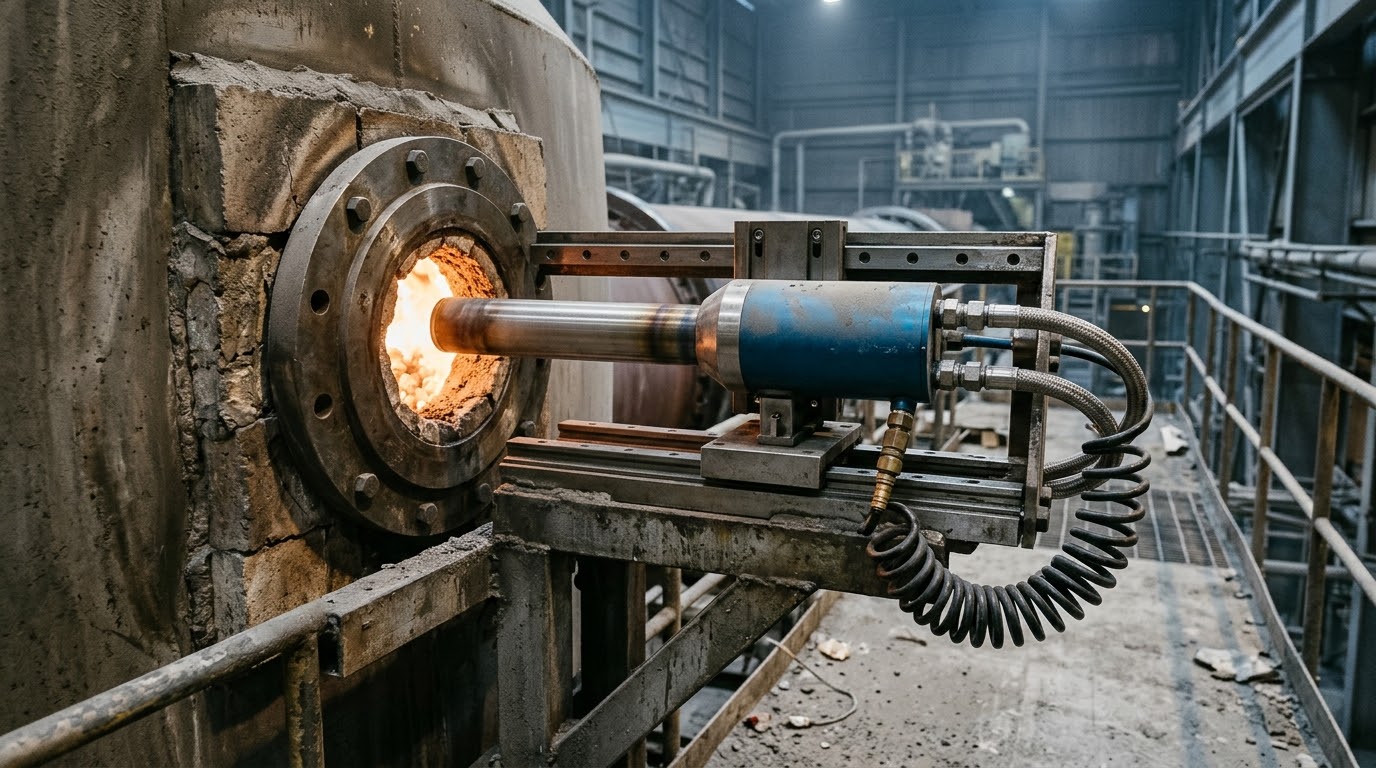
A kiln camera specification has to fix nine things before it goes out to tender: field of view at the actual working distance, probe length against total wall build-up, furnace radiant temperature and ambient temperature as two separate numbers, cooling method with flow and pressure minimums, purge and ingress protection, retraction triggers and their thresholds, signal output to the DCS, whether the plant is buying visible imaging or temperature measurement, and spares and warranty scope. Every clause left vague here becomes a commissioning dispute later. This guide gives the wording to write, the value to demand, and the reason each one matters.
Key Takeaways
Most kiln camera failures on site are specification failures, not product failures.
Furnace radiant temperature and ambient temperature at the flange are different numbers. Specify both.
Retraction thresholds are the most useful safety clause, and almost nobody writes them down.
Cooling air and water consumption are permanent operating costs. They belong in the bid.
Warranty length means little. Scope — parts, labour, travel — means everything.
1. The Camera Is the Cheapest Line in the Decision
A kiln camera is a small fraction of what a wrong specification costs. The expensive parts are the ones nobody puts in the quotation: a 200 mm port cut in the wrong place on a kiln shell, a cooling air line sized for one probe and expected to feed four, a DCS point list that arrives after the control system is already configured.
Procurement teams tend to compare cameras on price and specifications on trust. The reversal is more useful. Cameras from established suppliers converge on price within a narrow band. Specifications diverge enormously, and the divergence is where projects are won or lost.
This guide covers the clauses that carry that risk. Each section gives the wording to write, the value to demand, and the reason it matters. For the equipment side of the same decision, see our kiln head high-temperature monitoring system and the wider range of cement industry monitoring applications.
2. The Nine Specification Lines That Decide the Outcome
2.1 Field of View at the Working Distance
Do not accept "wide angle" as a specification. Ask for the angle of view range and the optical zoom range, then convert to metres at your actual working distance.
A kiln hood camera typically looks 2–6 m at the flame and the burning zone. A grate cooler camera looks 1–3 m at the clinker bed. A float glass camera looks across the melt at a distance set by the furnace width. These are different optics and they are not interchangeable. The same principle applies across float glass furnace applications and metallurgical furnace applications, where viewing distances are set by vessel geometry rather than by the camera.
Convert with: field width ≈ 2 × distance × tan(angle ÷ 2).
A camera with an 81° wide end covers roughly 6.8 m at 4 m distance; the same camera at 17° covers roughly 1.2 m. That range is what optical zoom buys you — the ability to frame the whole flame or read the burner tip without moving the probe.
Write it as: "Angle of view shall be adjustable from at least 17° to 81°, with optical zoom not less than 27× and a focal length range of 3.6–78 mm. At the specified working distance of 4.0 m, the wide end shall cover not less than 6 m of field width."
Confirm whether the quoted angle is horizontal, vertical or diagonal. The three differ enough to matter at 4 m, and only one of them is the number you actually need.
2.2 Probe Length Against Wall Thickness
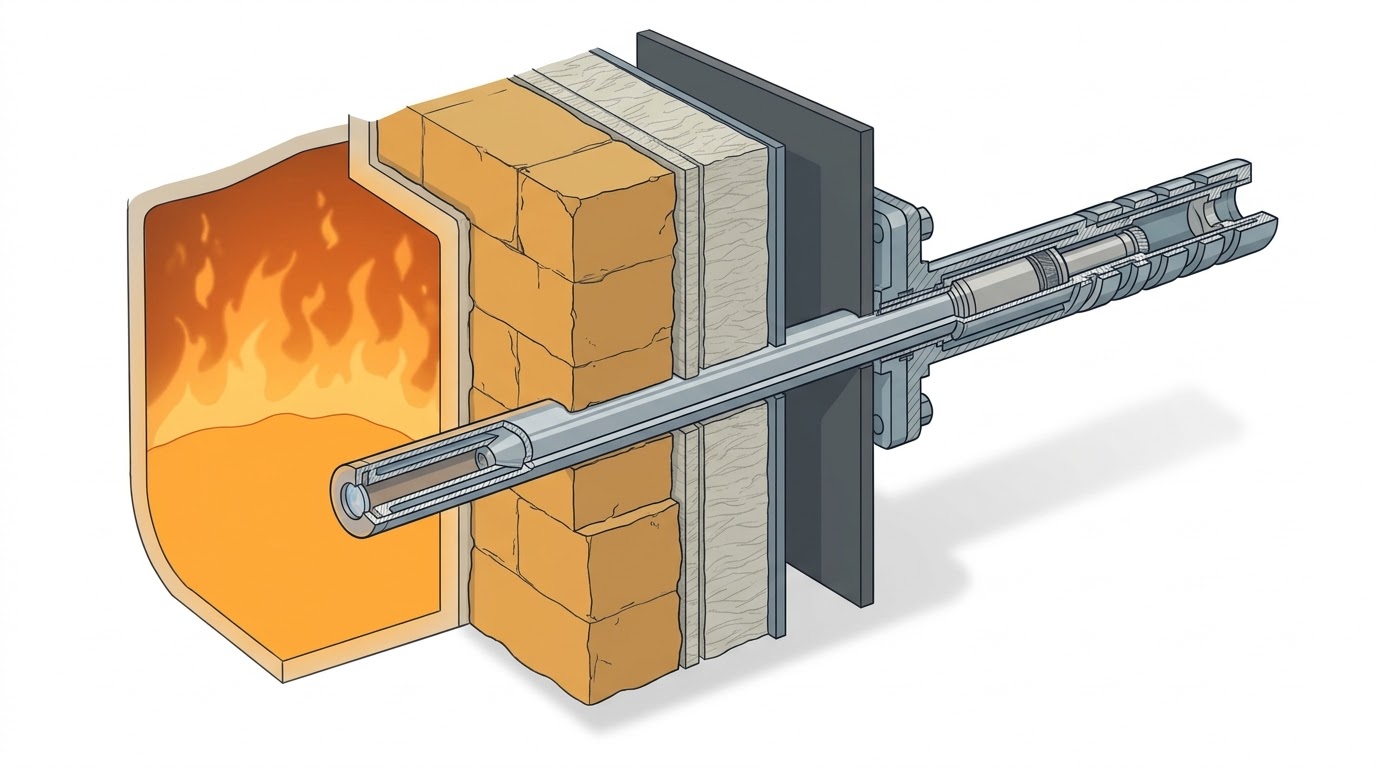
The probe has to pass through the refractory, the insulation, the shell and the mounting flange, and still leave retraction travel. Specify the total wall build-up, not just the shell.
Write it as: "The system shall accommodate a total wall build-up of up to 500 mm (refractory, insulation, shell and flange combined), with a probe length of 500 mm and a retraction stroke of not less than 450 mm."
Probe length is the single hardest item to correct after installation. A probe that is too short cannot be extended in the field without a new port. A probe that is too long can be shimmed. When the wall build-up is uncertain, specify long and plan to trim.
The retraction stroke is a separate number and is often forgotten. A probe that withdraws 200 mm out of a 500 mm wall is still sitting in the hot zone — the retraction has protected nothing.
2.3 Furnace Radiant Temperature and Ambient Temperature Are Two Numbers
This is where most datasheets mislead, usually without intent. "Rated to 1700 °C" describes the radiant heat the lens window sees inside the furnace. It says nothing about the temperature of the housing on the operating platform.
Write both: "The optical head shall operate continuously with a furnace radiant temperature of 1700 °C, and the retraction assembly shall be rated for ambient temperatures from −20 °C to 100 °C at the mounting position."
The ambient figure drives the cooling design. On a cement kiln hood platform, ambient at the flange commonly runs 50–100 °C depending on distance and airflow. On a blast furnace top or a reheating furnace sidewall it can be higher. If the bid only quotes the radiant number, the cooling system has not been specified at all.
Note the two numbers describe different things. One is a process temperature the equipment endures; the other is a working environment the equipment lives in. Vendors that quote only one are either simplifying or have not separated them.
2.4 Cooling Method and Utility Consumption
Air cooling and water cooling are not equivalent options at equal cost. They carry different infrastructure requirements and different failure modes. Most kiln head systems use both, with water as the primary circuit and air as purge and secondary cooling.
Compressed air needs instrument-quality supply, dry and oil-free. Specify pressure range, minimum flow and inlet temperature — not just pressure.
Typical values for a kiln head system: "Compressed air inlet 0.3–0.7 MPa, minimum flow 0.3 m³/min (18 Nm³/h), inlet temperature ≤35 °C, dew point ≤−20 °C, oil content ≤1 mg/m³."
Cooling water needs a defined flow, pressure and inlet temperature, plus a water-quality limit.
Typical values: "Cooling water inlet 0.2–0.5 MPa, minimum flow 0.8 m³/h, inlet temperature ≤35 °C, hardness and suspended solids within the limits stated in the manual."
Now the clause that most specifications miss: the difference between the operating minimum and the protection threshold.
Take a system whose water circuit needs 0.8 m³/h to run properly, but whose retraction logic trips at 0.2 m³/h. Those two numbers define a band — between 0.2 and 0.8 m³/h the camera keeps running while slowly losing thermal margin. Nothing alarms. The damage accumulates over months.
The same system may set the air pressure trip at the same 0.3 MPa it quotes as the minimum. Here the band is zero: the protection threshold equals the operating minimum, so any drift trips immediately.
Neither design is wrong, but they are different, and the buyer should know which one they are getting. Write it as: "The bid shall state both the minimum flow for continuous operation and the threshold at which automatic retraction occurs, for each cooling medium."
A specification that states only one number per medium has not described the protection scheme at all.
2.5 Purge and Ingress Protection
A kiln camera does not fail from heat as often as it fails from a dirty window. Positive purge keeps dust and process gas off the optical path and keeps the lens cool.
Two design details matter more than the headline claim. The first is the air curtain geometry — a tangential or spiral curtain sweeps the window continuously, while a straight jet leaves a stagnation zone at the centre where dust settles. The second is the window material; sapphire resists both thermal shock and abrasive dust far better than glass, at a cost. Both are covered in the high-temperature lens range.
Write: "The optical path shall be protected by continuous positive purge with a spiral or tangential air curtain and a sapphire window. The bid shall state the IP rating of the housing and of the cable entry, with the supporting certificate."
Specify the purge medium. Plant air carrying oil aerosol will fog the window within weeks. Nitrogen is used where the process atmosphere is flammable.
2.6 Retraction Triggers and Thresholds
This is the clause that separates a camera from a protected system, and it is the one most often left out of the bid.
A retraction system should withdraw the probe automatically on any of the following:
Housing or hood temperature above a set threshold (commonly 50 °C, adjustable).
Compressed air pressure below the set minimum (commonly 0.3 MPa).
Cooling water flow below the set minimum (commonly 0.2 m³/h).
Loss of electrical power.
A retraction command from the control room or field device.
Any of the above generating an alarm at the DCS.
Write all six into the bid, with the actual threshold values. Then add: "Retraction shall be fail-safe, requiring no external power or control signal to complete the stroke."
That last sentence is the one that matters. A retraction system that needs power to retract has not solved the power failure case, which is the case most likely to destroy a probe.
Ask also what drives the stroke — spring return, counterweight, or a motor with a stored-energy element. The answer decides what happens in a power failure, and it is the one question worth asking twice. A spring-return design retracts when everything else has failed; a motor-driven design retracts only while it still has power.
2.7 Signal Output and DCS Integration
State the resolution, frame rate, physical interface and protocol. Then require a point list.
Write: "Video output shall be 1920×1080 minimum with the interface type stated in the bid. Remote control of aperture and menu parameters shall be provided. A complete I/O point list shall be issued with the bid, listing every tag, address, data type and scaling factor."
The point list is the deliverable that saves the most time later. It defines everything the control system needs to talk to the camera. Projects without one spend commissioning week reverse-engineering addresses.
Be specific about what "DCS integration" means in the bid. It can mean anything from a single alarm contact to full bidirectional control of lens functions. Ask for a written list of the functions that can be controlled remotely and the protocol used for each.
If the camera includes a 4–20 mA or digital temperature output, specify the range and scaling, and specify the fault behaviour — hold last value, drive high, or drive low. An undefined fault state is a control room hazard.
2.8 Visible Imaging or Temperature Measurement — Decide First
These are not upgrade tiers. They answer different questions, and specifying the wrong one produces a system that works perfectly and answers nothing.
Visible-light imaging shows flame shape, colour, stability and the burner tip. It is what an experienced operator reads to judge combustion. It is the right choice when the question is "what is the flame doing".
Infrared measurement gives a temperature field instead of a picture. Short-wave infrared suits flame and clinker in the high-temperature band; long-wave infrared suits kiln shell scanning at lower temperatures, where the question is refractory wear rather than combustion. The relevant product families are the infrared temperature measurement system and the video infrared thermal imaging system.
Shell scanning is a third thing again — a separate instrument that sweeps the rotating shell and maps hot spots, so that coating loss shows up as a temperature trend rather than as a hole.
Write the requirement as a question first: "The system shall provide [visible imaging / calibrated temperature measurement / shell temperature mapping] for the purpose of [flame assessment / combustion control / refractory monitoring]."
If temperature measurement is specified, add: "The bid shall state the measurement range, the spectral band, the accuracy, whether emissivity is adjustable, and the calibration basis and certificate."
The spectral band must be stated. A camera specified in the wrong band will read plausibly and be wrong, which is worse than reading nothing, because nothing alarms.
2.9 Spares, Calibration and Warranty Scope
Warranty length alone tells you little. Scope tells you everything.
Write: "Warranty shall be 24 months from commissioning, covering parts and labour. A recommended two-year spare parts list with unit prices and lead times shall be submitted with the bid. Annual calibration shall be quoted as a separate optional line item."
Four questions decide whether a warranty is real: does it include labour, does it include travel to site, what is the response time commitment, and what is excluded. A two-year parts-only warranty on a camera 4,000 km away is a one-year warranty in practice, because the second year costs more in shipping than the part is worth.
Ask explicitly whether consumables are covered — windows, purge filters, seals and O-rings are the parts that actually fail, and they are usually excluded.
3. How to Verify a Hazardous Area Certificate
Explosion protection is where specification meets paperwork, and the paperwork is checked more carefully than the hardware. Verify in this order. The hazardous area classification framework behind these checks is defined by IEC and NEC, not by any supplier.
1. Start from the area classification drawing, not the datasheet. Each installation point has its own zone. A kiln hood, a grate cooler discharge and a coal mill are not the same zone, and neither are a petrochemical furnace and a blast furnace top. Ask your process safety engineer to confirm the zone for the specific port location before any specification is written. See special explosion protection applications and petrochemical applications for the zones these ports typically fall into.
2. Match the marking string character by character. Take the string off the certificate, not off the brochure, and compare it to the string on the nameplate. Zone 21 equipment does not satisfy Zone 20, and Zone 22 equipment does not satisfy Zone 21. Inspectors read the nameplate, not the datasheet.
3. Check the temperature class against the real surface temperature. A temperature class is a ceiling on surface temperature, not a description of it. A T135 °C rating is worthless if the housing reaches 160 °C in service, and poorly cooled designs exceed their own class routinely. Ask for the measured housing temperature at site ambient, not the class alone.
4. Verify the certificate number with the issuing body. Ask for the certificate itself, not a scan of a badge. Check that the certificate scope covers the specific model, the specific marking and the specific zone. Certificates are issued per product family and per marking; a valid certificate for one model proves nothing about another.
5. Know which system applies where. Certification schemes are regional, and they do not transfer.
| Scheme | Region | Notes |
|---|---|---|
CCC | China | Required for domestic installation; commonly what Chinese suppliers hold |
ATEX | European Union | Required for EU placement; directive 2014/34/EU |
IECEx | International | Accepted in many markets; often the practical route for Southeast Asia, Middle East, India |
NEC / CEC | North America | Class/Division or Zone system; separate certification |
Certification is per product, per marking and per zone. A certificate held for one model tells you nothing about another, and a scheme held for one region does not travel to another. Establish in writing, before the PO, which certificate the delivered unit will carry, which marking string will appear on its nameplate, and who is responsible if either differs from the contract.
4. Copy-Ready Specification Template
The table below is the clause list in the order it should appear in a technical bid. Values are typical for a kiln head system and should be adjusted to the specific port.
| Clause | What to Write | Typical Value |
|---|---|---|
Field of view | Angle range, zoom, width at working distance | 17°–81°, 27× optical, ≥6 m at 4 m |
Probe length | Total wall build-up + retraction stroke | 500 mm build-up, ≥450 mm stroke |
Furnace rating | Continuous radiant temperature | 1700 °C |
Ambient rating | Temperature at mounting position | −20 °C to 100 °C |
Cooling — air | Pressure, minimum flow, quality | 0.3–0.7 MPa, 0.3 m³/min, ≤35 °C inlet |
Air quality | Dry, oil-free, filtered | Dew point and oil content stated |
Cooling — water | Pressure, minimum flow, inlet temp | 0.2–0.5 MPa, 0.8 m³/h, ≤35 °C |
Protection band | Operating minimum vs retraction threshold | State both, per medium |
Purge | Curtain type, window material | Spiral air curtain, sapphire |
Ingress protection | Housing and cable entry | State rating + certificate |
Retraction triggers | Six conditions with thresholds | Temp, air, water, power, command, alarm |
Retraction fail-safe | Action without power or signal | Full stroke, no external power |
Video output | Resolution, interface, frame rate | 1920×1080, interface stated |
Remote control | Functions controllable from DCS | Aperture and menu parameters |
Point list | Complete I/O schedule | Submitted with bid |
Temperature (if specified) | Range, accuracy, band | Bid states all three |
Warranty | Duration, scope, exclusions | 24 months, parts + labour |
Spares | Two-year list, prices, lead times | Submitted with bid |
Calibration | Interval, basis, cost | Annual, optional line |
5. Acceptance Tests to Write Into the Contract
List these in the technical bid, not in the commissioning plan. A test that is not in the contract is a favour, not an obligation.
Cold imaging and field-of-view check. Target board at working distance, measure coverage against the specified width at both zoom extremes.
Retraction function test. Trip each of the six triggers individually, confirm full stroke and confirm the DCS alarm.
Fail-safe retraction test. Remove power during operation, confirm the probe retracts without external assistance.
Pressure and leak test. Purge circuit and cooling circuit, at the working pressure, held for 30 minutes.
Certificate and nameplate verification. Marking string, temperature class and certificate number against the area classification drawing.
72-hour continuous run. Full thermal load, at site ambient, no intervention.
DCS point list verification. Every tag addressed, scaled and displaying correctly, with measured latency.
Temperature verification — only if a measurement system is specified. Certified reference source at three points across the range, deviation recorded against the stated accuracy.
Items 2, 3 and 7 are routinely skipped and routinely cause the longest delays. A retraction system that has never been tripped is an untested safety device. Video that arrives two seconds late is not usable for combustion control.
6. Five Specification Mistakes That Cause Rejection
Writing "high temperature" without a number. The word appears in every brochure and constrains nothing. Radiant and ambient figures constrain everything.
Using the peak rating as the continuous rating. A camera quoted at 1700 °C peak may be rated lower continuously, and the bid usually shows only the bigger number. The difference is the difference between a two-year life and a two-month one.
Specifying cooling pressure and flow but not water quality. Hardness and suspended solids scale the jacket, heat transfer falls, and the camera overheats months later with no obvious cause. Specify hardness and filtration.
Letting civil works define the port. The port size and position should follow the camera's optical requirement, not the convenience of the shell contractor. A port 150 mm off-centre permanently limits the view.
Specifying warranty by duration only. Two years of parts is not two years of support. Scope, travel, response time and exclusions are the clauses that get used.
Frequently Asked Questions
What temperature rating should a kiln camera have?
Two ratings, not one. Specify continuous furnace radiant temperature at the lens (commonly up to 1700 °C for cement and glass furnaces) and the ambient temperature range at the mounting position (commonly −20 °C to 100 °C for a retraction assembly). The radiant figure sizes the optics and cooling; the ambient figure sizes the housing and determines whether the design survives the platform it sits on.
Air-cooled or water-cooled — which should the specification require?
Most kiln head systems use both: water as the primary cooling circuit and air for purge and secondary cooling. The deciding factors are utility availability, ambient temperature at the flange and maintenance access, not purchase price. If only one medium is available, say so in the bid — a supplier quoting a water-cooled system to a plant without a reliable water supply has not understood the site.
How long should the kiln camera probe be?
Long enough to pass the refractory, insulation, shell and flange, plus a retraction stroke that clears the hot zone. Specify the build-up and the stroke separately; a probe that withdraws 200 mm out of a 500 mm wall has protected nothing. When the build-up is uncertain, order long — a probe can be trimmed, but a short one needs a new port.
Why do the cooling flow minimum and the retraction threshold differ?
Because they describe different things. The minimum flow is what the camera needs to run within thermal margin. The retraction threshold is the point at which continued operation risks destroying the probe. Between the two is a band where the camera runs, slowly loses margin, and raises no alarm. Ask for both numbers for every cooling medium, and ask which alarms exist inside that band.
What should be specified for DCS integration?
Specify the functions, not just the phrase. List which parameters can be read and which can be controlled remotely — aperture, menu settings, retraction — and the protocol for each. Require a complete I/O point list with the bid, including tag names, addresses, data types and scaling. Also specify the fault behaviour of any analogue output, since an undefined fault state is a control room hazard.
Do I need ATEX or IECEx certification for a kiln camera?
It depends on where the plant is and whether the installation point is classified. Chinese installations require CCC certification. EU installations require ATEX. Many Asian and Middle Eastern projects accept IECEx. North America uses NEC Class/Division or Zone. These schemes do not transfer: a unit certified for one scheme needs separate certification for another. Ask for the certificate number, the issuing body and the marking string at bid stage, and make the delivery schedule depend on certification rather than production.
Should calibration be included in the specification?
Yes, as a separately priced line item — for measurement systems only. Specify the interval (annual is typical), the basis, the accuracy tolerance and whether the service includes on-site travel. Cameras that are never calibrated drift slowly and plausibly, and a drifting temperature reading is more dangerous than a failed camera because nothing alarms. Visible-light cameras need window cleaning and purge filter changes instead, which belong on the same maintenance schedule.
How do you compare two kiln camera quotations fairly?
Normalise both to the same clause list, then add five years of operating cost: cooling air and water consumption, spare parts at quoted prices, calibration, window and filter replacement, and the labour to do it. The lower purchase price frequently carries the higher total. A specification template makes the comparison mechanical rather than rhetorical. Our furnace camera systems guide covers the cost side of that calculation in more detail.
Need a Clause-Level Specification for Your Furnace?
Luming has built high-temperature monitoring systems for cement, float glass, metallurgical, nuclear and petrochemical applications since 2013, with ISO 9001, Chinese explosion-proof certification (CCC) and installations across Southeast Asia and Central Asia. Send us your wall build-up drawing and working distance, and our engineers will return a specification clause list you can drop into your bid package — no obligation, no sales call required.
Request a Specification ReviewRelated Reading
Recommended Products
Recent News
1.Can You Put a Camera in a Kiln? The Complete Guide to Cement Rotary Kiln Monitoring
2025-08-192.High Temperature Cameras for Furnaces and Kilns
2025-12-243.Cement Kiln Monitoring Guide: Shell Scanning & Burner Optimization
2026-05-124.swir-vs-lwir-thermal-sensors-kiln-camera-selection-guide
2026-05-115.Rotary Kiln Monitoring System: Prevent Costly Downtime in Cement, Steel & Lime Plants
2026-04-30